During World War I, the U.S. Department of War invited Robert Yerkes and his colleagues to develop and implement a series of tests examining the intellectual abilities of its soldiers. The tests known as the Army Alpha and Beta Tests constituted the first empirical aptitude and ability studies carried out with sample sizes (over 1 million participants) sufficient for rigorous statistical analysis. They uncovered appalling deficiencies in the education of Americans. The worrisome results jolted the country. Federal and state governments began to confront the challenges of offering an education to the broad populace that would meet the needs of a rapidly developing industrial nation. The test results eventually inspired the G.I. Bill of 1944.
The fabled World War I hero Sergeant Alvin C. York did not need sophisticated statistical analysis to recognize the shortcomings of education in his world. He owned a farm in East Tennessee and knew the problem first hand. After military service, he spent much energy and a large part of his own assets to found a secondary school for the children of Fentress County. The Alvin C. York Institute was founded in 1927. Classes began in 1929. Though much progress has been made since, great need remains. The Tennessee Economic Council on Women reports that 59 % of the women living in Fentress County graduated from high school in 2000. That is about 15 % fewer than in the nation, according to a recent National Women's Law Center report. Only 6 % graduated from a four-year college.
The Institute was eventually incorporated into the public school system. In 1980, the original building was deemed too expensive to repair. The old facilities were closed and new ones were built on the premises. Now the old building is slated to be torn down. It is registered in the National Register of Historic Places. Members of the York family and friends of the Institute are attempting to raise funds for its preservation.
The Tennessean's Rachel Stults reports in her article entitled "Family, preservationists rally to save York's dream" published Apr. 22, 2008, that the building's years may soon be counted. Restoration would cost a daunting $ 5-10 million. Neither the state nor the county government are prepared to provide this large sum for a project that does not seem to help address persistent urgent needs. Can there be a rationale for investing 10 million dollars in a dilapidated building far from any economic hub of note?
The answer is yes. Tennessee's countryside is beautiful. Costs of living are low. It is a perfect location for industries that do not need to be near metropolitan areas, yet want a seat in the U.S. Internet-oriented services and e-commerce come to mind. Such high technology-oriented enterprises commonly hesitate to settle in rural areas, because the local work force does not have the expertise they seek. Like any high school in this state, today's Alvin C. York Institute already attempts to seed the knowledge for such jobs. A learning center for computer sciences in secondary education would greatly enhance the effort. The center could lend OLPC to those who cannot afford a computer. The little machines are also known as XO computers. They constitute cost effective, robust and powerful slim clients. I wrote about them in my post on this site on December 7, 2007, and am writing this post on one.
Instruction in the use of computers would help the children to develop the understanding and the skills needed to embrace the world wide web and elicit interest in internet careers. The preparedness for college would improve. The center's seat in the building that Alvin C. York conceived to bring opportunity to his people through education would represent a beacon of hope for those who live in rural America and feel left behind by the innovations of the 21st century. It would demonstrate that York's dream can be fulfilled. The symbolism is priceless.
Friday, June 27, 2008
Sergeant York's School House

Monday, June 23, 2008
The Brain: A Giant Self-Medicating Gland
The use of psychoactive drugs is older than humanity. Primates have been observed to deliberately feast on fermenting fruit rich with alcohol. The debate over the benefits and perils of treating mental disorders with psychoactive drugs has been unrelenting and passionate among patients, physicians and scientists. Alternative treatments promising improvement are hotly disputed. Two recent articles in The New York Times highlight the substantial public attention paid to these issues.
The first one, published online Apr. 15, 2008, was written by Richard Friedman M.D., a concerned physician who worries about the presently unknown health effects of life-long medication beginning at an age when our brain still develops. The prescription of anti-depressants to youngsters diagnosed with adolescent depression is used as an example. Brain and mind may develop differently with the constant exposure to these drugs. The body will be burdened with a foreign compound for a life time. The author argues convincingly that more research is needed to examine the long-term effects of the chronic exposure to psychoactive drugs. This concise, informed, and sensitive contribution initiated comments from 360 readers.
The second article, published online Jun. 16, 2008, is a post by Tara Parker-Pope describing therapies for Attention Deficit Hyperactivity Disorder alternative to conventional drug treatments. The article has attracted 160 comments to date. Prudence is advised when examining the options discussed in this post. The assessment of recently developed treatments is wrought with difficulty. The time for gathering experience with a novel therapy is commonly too short to allow a valid comparison with the risk/benefit analyses of established therapies supported by large bodies of data.
It is important to emphasize that any type of intervention will influence the biochemical make-up of the brain. The nerve cells in the brain produce psychoactive substances and modify their production at all times. The nerve cells excrete chemical substances known as neurotransmitters to communicate with each other. Neurotransmitters affect the behavior of nerve cells immediately. The predominant excitatory neurotransmitter is glutamate. Glutamate bound to specific receptors on the cell body surface stimulates the production of electrical signals known as action potentials. Action potentials travel along the nerve cell's outgoing arbor, i.e. its axon, and exact the release of neurotransmitters at its contacts with other nerve cells known as synapses. Gamma-aminobutyric acid, by contrast, inhibits the production of action potentials. Acetylcholine, norepinephrine, dopamine, and serotonin may influence neural behavior more persistently and are also known as neuromodulators, playing crucial roles in psychiatric disorders. Opiates constitute the purest type of neuromodulator, because they do not act as neurotransmitters. Eventually, it is important to understand that some neurotransmitters can excite or inhibit nerve cells, depending on the type of receptor they bind to.
Compared to neurotransmitters and neuromodulators, however, hormones exert the longest lasting effects on the brain. When I was a student I participated in research on the Siberian hamster Phodopus sungorus of Siberia in the laboratory of Professor Gerhard Heldmaier (Rafael and others, 1985). These amazing creatures are only the size of a mouse. Yet, they cope with the frigid temperatures of Siberian winters. They grow a thick white coat for the winter and can rely on paws padded with dense fur even on the palms. But, the key to the hamsters' survival is the brown body fat, known as brown adipose tissue or BAT for short, that they build up before snow fall sets in. The hamsters are crepuscular, that is they are most active during the twilight hours of the day. As the light grows more orange and the days grow shorter, the hamsters forage more intensely for food, almost double their body weight, and their physiology changes. Come Winter, the hamsters can resist deep freezer temperatures as low as -70 °C for many hours without any harm, using their brown body fat to maintain body temperature. When the brown fat is depleted, they begin to shiver and die in short time. By contrast, animals unconditioned during the autumn would perish already at -30 °C.
The hormone melatonin is thought to play a crucial role in the hamsters' seasonal behavioral and physiological changes. Nerve cells in the brain's pineal gland secrete this hormone into the blood stream. The cells are light sensitive and increase hormone production, when the animals are more exposed to long wavelength-rich autumn light and extended nights. Heldmaier and others (1981) observed that hamsters that were artificially maintained at long daylight hours in the autumn, developed only mild cold resistance. However, their sensitivity to melatonin was enhanced. Chronic administration of melatonin increased cold resistance in these animals. By contrast, short daylight-adapted hamsters showed the anticipated increase in cold resistance and no sensitivity to melatonin treatment. Summer- and winter-adapted hamsters are shown in the video below.
Melatonin does not only govern the Siberian hamster's life. It plays a crucial role in the bouts of depression that people living above the polar circle confront during the long and dark winters. The control of nerve cell function through a substance that nerve cells produce in response to environmental changes constitutes a powerful demonstration of experience-dependent brain self-administration.
Normally, the nerve cells in our brain are well poised to maintain control over the diverse processes that keep our brain's biochemistry in balance. However, genetic predisposition, developmental mishaps, and traumatic experience may sway that balance toward extremes beyond control. We may be able to bounce back by just taking time out, re-balancing our brain and calming our mind. If our own coping mechanisms do not suffice, we need professional help.
Psychotherapies have proven effective for some. Yet, success seems subtle. Time is needed to produce measurable results. By contrast, drugs targeting specific neurotransmitters are known to restore functionality quickly and robustly. An overwhelming number of comments from affected people sent to The New York Times supports this contention. But, there is no reason to believe that substances purified from natural products should be a priori more beneficial than pharmaceuticals synthesized in laboratories, solely because the former originate in nature. Only thorough research and experience will tell which drugs produce positive results regardless of provenance.
Drug therapies entail one drawback. The substances are administered systemically. That is, they are injected or ingested and absorbed by the whole body, although their intended targets may only consist of small regions of the brain. Other organs may be susceptible to the drugs. notably, the walls of the intestines contain more nerve cells than the brain. The intestinal nerve cells possess receptors similar to those found on brain nerve cells and may respond to the drugs with adverse effects on digestive function.
Moreover, drugs accumulate in the liver. Foreign chemical compounds are made water-soluble by oxidative liver enzymes. The increased concentration of the drugs may induce detrimental hyperactivity of these enzymes. The load that the metabolites add to the kidneys, where they are excreted with the urine, may damage kidney tissue. The risks mount, when medication begins early in life. But as Dr. Friedman so validly pointed out in his article, we simply do not know at present what the precise consequences of the life-long exposure to psychotherapeutics will be.
Therapies that are targeted only to the brain regions involved in the disorder would reduce the risk of adverse effects. Psychotherapeutic drugs are designed to target specific receptors on nerve cells and modify the molecular pathways that are particularly involved in a specific disorder. However, their action could be directed to specific brain regions only, if they were infused directly into the tissue, requiring a craniotomy.
By contrast, biofeedback-based therapies may improve nerve cell function locally without invasive intervention. Cognitive therapies can be considered as providing biofeedback, if they concentrate on the behavioral manifestations of the disorder and address specific symptoms. Conscientious modification of behavior may re-adjust the biochemical balance of the involved brain regions and this re-adjustment may conversely improve the behavior. Other therapies involving biofeedback consist of learning to play a musical instrument or a sport. These methods challenge sensory and motor skills. They demand focus and render immediate sensory feedback. With practice, brain function and skill improve concomitantly.
Neurofeedback, e.g. BrainMaster, is a technologically more sophisticated extension of the behavioral interventions described above. Electrical brain waves are recorded from the scalp with button electrodes. The power of these brain waves is used to inform the participants whether they are making progress in the desired direction. The measurements can be displayed in dynamic graphs on computer screens or integrated into computer games. I have written about such electroencephalographic techniques and the experience I had with equipment manufactured by J&J Engineering in my post published on this site on May 24, 2008. The brain waves of interest are known as alpha waves. Their profound role in mental focus can be explored with Mind ball popular in science museums.
Neurofeedback is an emerging technology and several comments to Parker-Pope's article lament its shortcomings with frustration. The applications using this technology must be sufficiently flexible to accommodate the very specific needs of the participants. Costly, time-consuming experimentation may be needed to find effective parameters in each instance. Moreover, the recordings of the minuscule surface potentials from the scalp are sensitive and easily compromised. Thick hair diminishes conductance and attenuates the strength of the recordings. Firm contact between the electrodes and the scalp needs to be established with sufficient amounts of conductance paste that must not dry out during the session. The impedance of the electrodes needs to be held stable to produce accurate and reproducible measurements of brain wave power. Thus, participants need to be fully cooperative and must be careful not to pull on the recording wires. Failing at any step may render the whole session useless.
References
- Heldmaier G, Steinlechner S, Rafael J, Vsiansky P (1981) Photoperiodic control and effects of melatonin on nonshivering thermogenesis and brown adipose tissue. Science 22:917-919.
- Rafael J, Vsiansky P, Heldmaier G (1985) Increased contribution of brown adipose tissue to nonshivering thermogenesis in the Djungarian hamster during cold-adaptation. J Comp Physiol B 155:717-722.
Revised: 01/30/2012
Sunday, June 22, 2008
Morat: Triumph of Free Will
“The idea of America endures. Our destiny remains our choice. And tonight, more than two centuries later, it’s because of our people that our future is hopeful, our journey goes forward, and the state of our union is strong.”President Barack H. Obama in his State of Union Address, Jan. 25, 2011 (added on the following day).
Today, Jun. 22, in 1476, the Swiss Confederation won a decisive battle against Charles II, Duke of Burgundy, known as the Bold. This account of the event is mainly based on the Freiburger Geschichtsblaetter, vol. 60 (1976). A good summary is available on the web here. A formidable depiction of the battle can be found here. Charles II was a highly educated feudal lord with a penchant for war as a tool to fulfill his territorial ambitions. This renaissance ruler oversaw a wide swath of land across Western Europe from the shores of the North Sea to the shores of the Mediterranean. The wealthy Swiss cities on the Eastern borders of his realm infringed upon his zone of influence and also promised a good additional source of income for his treasury. From adolescence, the Duke was unrelenting in his effort to keep the wealthy cities of the low lands on the North Sea under his control. A campaign to subdue wealthy Swiss cities was an eastward extension of this policy.
In January 1476, Charles marched an army of about 28,000 professional soldiers equipped with the most advanced artillery of his time toward Western Switzerland. The region around Lake Geneva was under the rule of the Count of Savoy who was allied with the Duke. On February 8, the troupes crossed the Jura mountains into Switzerland and soon attacked the town of Yverdon on the banks of Lake Neuchâtel. The town had been occupied by the Swiss Confederation in the preceding year. Now the occupiers abandoned their position, burning down everything behind them. They withdrew to the fortress at nearby Grandson with the Duke's men in hot pursuit. The Duke ordered a siege. On February 21, the Confederates surrendered on promise of free conduct. As the men filed across the drawbridge disarmed, they were taken to a mighty tree nearby and hanged one next to the other from its branches. The fortress has survived intact and houses the municipal administration today. The tree also survived. It is huge with numerous massive, horizontal branches. There is easily space for a score of bodies on each. Contemporary depictions of the despicable act show rows of corpses strung up like chicken on a line. Reportedly, a total of 412 men were strung up in the tree within 4 hours.
In retaliation, the Confederates surprised the Duke's army in the vicinity of Grandson on February 27 and captured a good part of the artillery. Most importantly, they happened upon the Duke's treasure of legendary riches. Its bounty was so exorbitant that the looters fought over their shares for a number of years. A peace treaty was needed to put the quarrels aside for once and all.
The gruesome end of the Confederates at Grandson sent a clear message to the towns in the region. Commonly, the burghers avoided armed conflict. Negotiating an agreement with the aggressors, even if it was costly, was often less disastrous than battle. Moreover, the burghers in West Switzerland did not care whether they paid taxes to some feudal lord or the city of Berne which dominated the region. Moreover, the francophonic locals felt more comfortable with the French culture of the Duke than with the Teutonic culture of the Swiss Confederates. Many small towns would have immediately switched sides in the face of the ducal forces, had the conditions of surrender seemed decent and fair. But, the horrible events at Grandson proved to the burghers that they could not expect benevolence from the Duke.
The second Burgundian thrust into Confederate territory started in June with a regrouped army of 21,000 men from fields above the city of Lausanne. On the march to the city of Berne, the army reached the town of Morat on the banks of the lake with the same name. The Burgundians began to lay siege on June 9.
The Bernese government had preempted a negotiated surrender of the town by sending the experienced commander Adrian of Bubenberg to oversee the local garrison. He ascertained that the burghers resolve did not falter in the bombardment of the Burgundian artillery. They had to hold out until the very end which was close on June 22. The Duke's heavy artillery had been persistently pounding the town's defenses. The wall and a tower had already crumpled in on the northern side three days earlier, but the defenders had repulsed the enemy's advance through the breach after eight hours of fighting. Now, it was only a question of time, until other breaches were wide enough for a final assault.
Bubenberg had written desperate pleas for help to Berne. The members of the Swiss Confederation were gathering an army to confront the Burgundians, with the Bernese constantly reminding the others of the oaths of mutual support they had sworn. This was no easy feat. The Swiss Confederation was not directed by a ruler, but was led by consensus. Plenty rivalry existed between regions and towns. Heated debates were raging whether it was wise or profitable enough to come to the rescue of the Bernese. Some compatriots felt it best to stay out of a conflict that did not affect them directly. In Zurich, the final decision to join the cause fell only days before the battle. Once it was made, 4,000 soldiers force-marched the 70 miles from Zurich to Morat in three days. Six-hundred did not arrive. During the night of June 22, the Zurichois united with the 25,000 Confederates and allies from Alsace and Lorraine that were already assembled behind a forest about 3 miles from the Duke's positions. Now, the Swiss outnumbered the Burgundians.
The Confederates had found in the Southern German Herter of Hertenegg an expert military leader for their endeavor. With the help of the Swiss captains, he managed to expediently whip the diverse lot into an attack formation that was classic in his time. The men were divided into a 5,000-strong avantguard, a 10,000-strong bulk and, arguably, a rear guard made of the rest of the troupes. The three battle groups were to enter the battle field in close succession. The avant guard was supported by 1,100 cavalry deployed on their left. Avantguard and bulk were to advance tightly packed in arrow formation with lancers wearing body armor on the flanks protecting the less armored helbard bearers in the middle from enemy projectiles.
Jockeying for the best positions and the most valiant jobs lasted into the morning. Promotions were handed out. The arguing went on. But the Swiss could not wait any longer. The militia men did not have any provisions. Hertenegg and 500 men rode to the forest's edge to view the enemy positions. Meanwhile, deployment for battle continued in the forest, though heavy rain fell.
The Duke's soldiers had been expecting the Swiss for days. They knew the location where they would emerge from the forest. The Duke's planners had set up a palisade fence and other fortifications to corral the Swiss militia men into a trap in the shape of an L with the short stroke, that is the line of artillery, pointing upwards and the long stroke, that is the line of archers, pointing sideways. On arrival the Swiss would be annihilated in a hail of arrows from the front and cannon fire from the right side. The enemy's left side opposite the artillery was left open for the charge of 2,100 cavalry, waiting behind the lines ready to mop up.
The Burgundians had been lying in their battle positions for several hours on this day and for hours on end on the days before. As on the other days, the enemy did not seem to attack. The weather was abysmal and lunchtime approached. The officers decided to stand most troupes down. At this very moment, the rain stopped and sun broke through the clouds. The Swiss avantguard advanced. The bulk of the force followed on their heals. The men poured against the Burgundian fortifications and were welcomed by arrows and artillery. Though only skeleton crews were at hand, the Burgundian army unleashed dense clouds of projectiles. Despite, the fiercely determined Swiss avant guard managed to breach and circumvent the fortifications within an hour. The cannon fell silent. The bulk of the Swiss force spilled like an avalanche through the breaches toward the Burgundian camps ringing the town. The Burgundians did not have a chance to ready themselves. Disarray and mayhem ensued. The Duke's officers tried to organize a counter offensive. The line faltered. The men took flight. A complete route unfolded. The Swiss succeeded in surrounding the fleeing troupes on three sides. The fourth side was taken by the lake. Countless Burgundian soldiers drowned or were drowned in a desperate attempt to flee across the water. It is said that a third of the Duke's army perished. The Duke and his immediate household escaped narrowly.
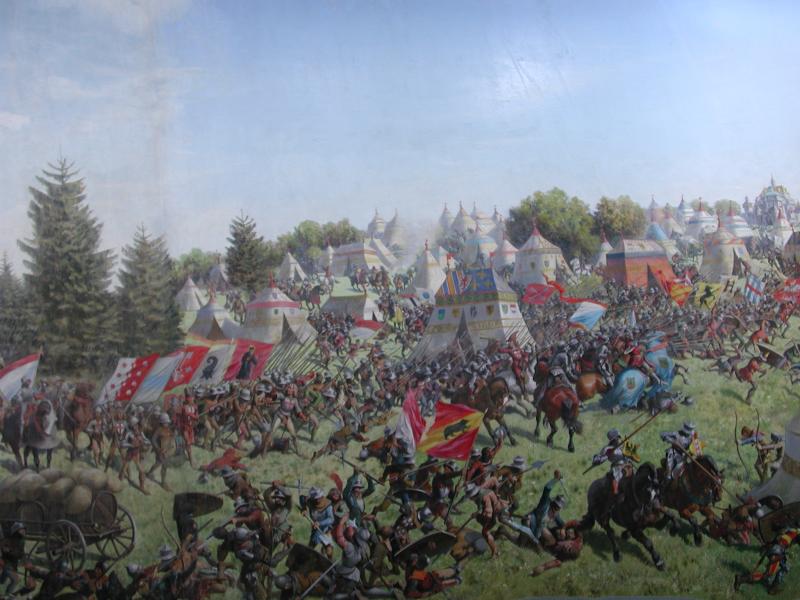 |
| Louis Braun, Schlacht bei Murten, 1893 |
 Tens of thousands of people from all over the world attend. Olympic medalists cover the distance in a bit more than 40 minutes. Morat looks very much the same today as it did at the time of the battle. Ramparts and towers survived.
Charles the Bold was a military man to the hilt whose confidence in battle was strengthened by several successes at young age. He was an involved leader and said to be popular with the soldiers. At the height of his Swiss campaign, he slept in battle dress until his limbs swell and he could not walk. He involved himself deeply and directly even in small affairs to the point that his commanding officers loathed his interference. On the downside, his inability to accept advice and his mistrust of those who were not members of his immediate household may have impeded effective leadership.
Yet, the strategy Charles used at Morat was consistent with the military thinking of his time. History had proved that victory belonged to those who picked the location of the fight and could prepare the battle field to their advantage. This commonly outweighed the disadvantage of having to wait for the enemy. The Duke commanded the best weapons of his time. He had introduced innovative battle formations combining different types of soldiers into fighting units in which they could complement each other. His standing army consisted of experienced professionals and practiced regularly. After the battle, the foreign military observers present and the Duke himself blamed the debacle on ill timing. Had everybody been on their battle stations, the Swiss would have perished for certain.
However, it can be argued that the Burgundian soldiers, most of whom were contracted, were no match against the independently-minded militia. The Swiss were bound only by their determination to win. Otherwise they were free to take any decisions they saw fit in the field.
The Duke's greatest flaw may have been his own inflexibility in judging the Swiss. This renaissance man fatefully stood on the threshold between the old and the new. He embodied the contradictions of a modern minded leader who loved technical innovation, but could not grasp the novelty in his enemy's mindset. The Swiss militia may have used crude, antiquated strategies on the battle field. Yet, they were motivated by a consensus solidly forged by communal deliberation. Common people making own decisions of this magnitude had no place in the feudal system. Charles II was a proponent of the God-given order in which he and his kind were entitled to all worldly decisions. Granting commoners too much freedom would bring only chaos. The Duke's subjects were rewarded as long as they gladly played the roles he assigned them in fulfillment of God's will. He saw it as his duty to severely punish those who rebelled against this order. Change was not acceptable.
At the time, the victory of the Swiss Confederates sent a profound signal across Europe. Like any other victory of commoners against feudal lords, this one proved that anyone could prevail, if they were free to use their abilities to the fullest. Success against the odds was possible, when the like-minded exercised solidarity and broadly shouldered the burden of action. The example of the Swiss Confederates demonstrated that anyone with resolve, unrestrained by feudal bondage and station, could take destiny in their own hand, take advantage of their abilities and use them to improve their circumstance of life. The events at Morat were at the beginning of a movement that would eventually lead to the Declaration of Independence and the Storming of the Bastille 300 years later. The persistent determination of the common people to free themselves from the feudal yoke precipitated the standard of living and the freedoms we enjoy today.
Addendum
- In his post on boingboing.net today entitled "Draft of Declaration of Independence named subjects, not citizens", Rob Beschizza describes in detail how Library of Congress researchers using hyperspectral imaging recently discovered an important change in Thomas Jefferson's draft of the Declaration of Independence. He first wrote "subjects", smudged out the wet ink, and replaced the word with "citizens". This small, willful change constitutes such an extraordinary example for the sea change in zeitgeist in Jefferson's time, reflecting the end of feudalism and the beginnings of modern society. It is yet another prove that free will exists (07/03/10).


